God’s Great Big Garden

They day was picture perfect, as a 140 young people from 7 different townships gathered to play a 3 on 3 soccer tournament. It is hard to explain the pure joy that permeated over the fields as the teams played in an environment so foreign to where they come from.

No gangs or violence. Bathrooms with running water. Two healthy meals provided. A whole lot of love and encouragement soaked up.

On Saturday a team of high school students from Parker Lutheran High School in Colorado helped at this event. They all jumped right in setting up, doing registration, preparing and serving meals, cheerleading, cleaning up, and even playing in a few soccer games.

As I walked around the fields taking it all in the words “planting seeds” kept popping into my mind. There was an overwhelming presence of joy apparent not just with the participants but with those who served. At the same time there was a sadness knowing most would return at the end of the time to difficult and dark places.

Yet, seeds of God’s Kingdom were planted on those soccer fields. Jesus’ parable of the growing seed in Mark 4:26-29 states:

“The Kingdom of God is as if a man should scatter seed on the ground. He sleeps and rises night and day, and the seed sprouts and grows; he knows not how. The earth produces by itself, first the blade, then the ear, then the full grain in the ear. But when the grain is ripe, at once he puts in the sickle, because the harvest has come.”
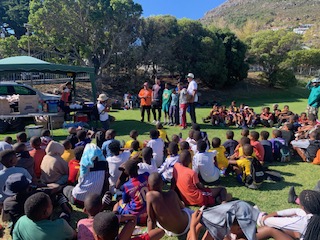
God was preparing hearts for His Kingdom seeds to be planted deeply into the hearts of these young people. I thought about all the different ways God was planting seeds that day. A Gospel message by Pastor Raymond before the event started. A generous gift from a friend in the US to Oceans to help make this day possible. Volunteers of all ages poured so much energy and time serving and loving on these young people.

But at the end of the day it comes down to a supernatural work of the Spirit of God. Just like the parable describes the farmer watching for the seed to sprout and grow, even though, “he knows not how.” Yes, God uses people to go out into the world with a message of His love through actions and His Word. But only He can change hearts, and what a huge big relief this is to know that part is in His hands.

The Father calls us to go into His big garden and plant seeds for His Kingdom by serving and loving others as He loved us. It is His Spirit that takes a dead seed, plants it in His Kingdom soil, and in His time brings the seed to life.

Today in faith may you plant a seed into the mystery of God’s Kingdom garden. Let Him use your hands, feet, and words, to testify to His supernatural saving love that causes a dead seeds to come alive and fill the earth with aroma of His Kingdom garden.

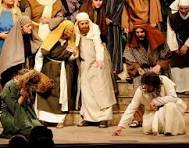
Face-to-Face with your Blessing

The other day I came face-to-face with a blessing in an extraordinary way. Bryan, the head master, of the school on our campus, and I were meeting with a man named Ken. Ken leads a network of Christian Schools in South Africa. The moment our meeting started a sense of peace permeated the room as Ken shared the vision for Christian Education. He clearly articulated how God can use it to raise up disciples who will impact the country with Christ’s Kingdom in their hearts.

After a tour of our campus Ken asked if he could pray over us.  Laying hands on us he prayed Aaron’s Blessing:

The LORD bless you and keep you; the LORD make His face to shine upon you and be gracious to you; the LORD lift up His countenance upon you and give you peace.” Numbers 6:24-26

After he prayed this he shared how he felt one passage which helps to interpret this Blessing is the story of Jesus and the woman caught in adultery  (John 8:1-11). How the woman caught in adultery by the religious leaders were using this to trip Jesus up and prove He was a law breaker. The law demanded her to be stoned and yet the religious leaders knew Jesus’ heart was full of mercy and grace.

Perhaps you remember how Jesus responded. He bent down and wrote something in the dirt with His finger. Then He stood up and said, Let him who is without sin among you be the first to throw a stone at her.”  Then He bent down again and wrote once again. How I wish we knew what He wrote because it was so powerful and convicting that each of those wanting to condemn departed, starting with the oldest to the youngest.

At that very moment she encountered the Blessing of Numbers 6:24-26, she saw the face of God shinning on her! For the first time in her life she knew a perfect peace deep in her spirit.

After Ken left I returned to our flat and felt drawn to dwell further in these texts. I could see how the gracious act of Jesus demonstrated the face of the Father loving His lost daughter to salvation. She could walk away with a new freedom of knowing her sins are forgiven and filled with a love beyond understanding which would be her new compass directing her life.

Ken’s blessing over us the other day and his explanation of it awakened my spirit to to the glorious face of Jesus who continues to shine brightly with a grace filled love. The Father does not hold our sins against us and continues by His Spirit to point us to His face of complete blessing found in Jesus.

I challenge you today to read the Blessing again and picture the hands of Jesus placed on your shoulder and His face glowing with glorious joy looking at you. Hear His words of blessing and let them fill you with the Spirit of the Father’s perfect peace. This is what you have been created for.

The Wedding Supper of the Lamb

Be blessed by the last of 3 blogs written by Ocean Board member Danell Czarnecki 

The Bride and Groom are at last ready to live together as husband and wife. The promise was made; the betrothal is sealed; the bride has been captured; the veil has been lifted; and the wedding feast is coming.  The wedding feast lasted for seven days, imagine the party!!

And the angel said to me, “write this: Blessed are those who are invited to the marriage supper of the Lamb.” Rev. 19:9

As the final preparations have been made; the wedding celebration begins. The bride and groom enter the huppah together, a canopy built to receive the new bride, symbolic of the beginning of a new household. Huppah, in Hebrew means covering or protection.

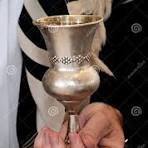
At this final step of sealing their union, a cup of wine is shared by both the bride and groom, from the same glass, called the cup of Redemption. After sharing the cup, a “breaking of the new glass” took place, representing the breaking away of the old, entering into something new.

In pondering the “breaking of the glass” tradition, I can’t help but be reminded of the destruction of the Temple in Jerusalem, and the breaking of Jesus on the cross, blending sorrow with hope, as the final act before the celebration. It also serves as a reminder that each of us, and the world, desperately need repair, even in times of great joy.

Jesus came as our Kinsman Redeemer to bring a new covenant, breaking away of the old and entering into something new. And we are invited to the marriage supper of the Lamb upon His return.

Following the pattern of an ancient Jewish wedding, Jesus invites His disciples to a banquet in an upper room the night before he’s crucified. (Passover) He initiates a betrothal ceremony and takes a cup of wine and says, this is my blood, a new covenant.

There are 4 cups of wine at the Passover; the cup of Sanctification (I will bring you), the cup of Deliverance (I will free you), the cup of Redemption (I will redeem you) and the cup of Praise (I will take you).  It seems Jesus did not drink from the final cup at the Last Supper; but He raised the cup and said “..I will not drink of this fruit of the vine from now on until the day when I drink it new with you in My Father’s Kingdom” (Mt. 26-29)

I think Jesus was alluding to the day when He returns and the last cup of wine is poured, the Cup of Praise, and we all partake at the wedding feast after the shofar has sounded and the bride has been captured.

John 14:1-3, Jesus says,

“Let not your heart be troubled; you believe in God, believe also in Me. In My Father’s house are many mansions; if it were not so, I wold have told you. I go to prepare a place for you. And if I go and prepare a place for you, I will come again and receive you to Myself; that where I am, there you may be also.”

Jesus is waiting to share the Cup of Praise until the time when He returns for His Bride and takes us to the marriage supper of the Lamb. What a glorious celebration that will be!

You have been chosen by the Father as worthy (1 Peter 2:9). The world’s love will fail you, hurt you and disappoint you; but the perfect love of your Heavenly Father and Jesus, your groom, will never fail; never disappoint and never leave you alone.

Your Mohar has been paid with the blood of Jesus Christ.

You have a Ketubah, the promises in His word are for you!

Jesus has offered you the Cup of Betrothal. 1 Cor. 11:24, “This is my body given for you..”

You’ve been given the gift of the Holy Spirit as Jesus returns to His Father’s house to prepare a place for you.

And Jesus has promised to return for you.

In anticipation of your Groom’s return; as you look forward to the Cup of Praise awaiting you in your everlasting Home; Jesus ask you, are your preparing yourself; are your garments ready? Is your lamp lit and your oil jars full? trust that I am coming for you…

Because no one know the time except the Father.  May He find us ready…

Unveiling the Bride

Blog Written by Oceans board member Danell Czarnecki.

In an ancient Jewish wedding, the last step before the wedding feast is called the Nissuin, or Home-taking. Nissuin in Hebrew means “to lift or to carry.”

Prior to the Nissuin, the couple are betrothed, but living as husband and wife. The groom has gone to prepare a place in his father’s house. The bride, waits for her groom to return for her. While waiting she prepares her wedding garments and keeps her lamp lit and oil jar filled at all times for she knew not when her groom would return. She was to stay pure and faithful, and would not be seen in public without a covering over her face; separating her from others. Veiling was a form of modesty and keeping oneself holy. It also communicated that she had been betrothed to another.

It was probably easy at first. But when his return was delayed, the bride may even doubt and start to question his return.

In the same way, we are the consecrated, betrothed bride of Jesus, awaiting His return. We cannot fall into the enemy’s trap and allow doubt and fear to become our guide. We must be ready at all times for the return of our Bridegroom.

Jesus refers to the tradition, in Mark 13:32 when he tells his disciples of his return, “but of that day and hour no one knows, not even the angels in heaven, nor the Son, but only the Father.”  

Then Jesus tells them parables to make sure they understand although He is going away it is important they live as a watchful bride; waiting for His return, living set apart for Him, and looking forward to the day when He comes again.

Once the groom’s father was satisfied that all was in order and prepared for the bride, friends of the bridegroom would sound the shofar and proclaim in the streets, “Behold the bridegroom cometh!” The bridegroom would then go with a procession to the bride’s house, usually at night, and “capture his bride.”

Once the bride and groom arrived at the father’s house, the final preparations for the wedding celebration would begin.

They would be separately immersed in the water called the Mikvah; symbolic of spiritual cleansing and to mark a new beginning. It was done as an important step in preparing the bride to receive her groom.

In Matthew 3:13-17, Jesus too was immersed (baptized) by John in the waters of the Mikvah at the Jordan River.

We are also asked to be immersed; setting ourselves apart and publicly declaring our devotion to Jesus.

Whoever believes and is baptized will be saved…” (Mark 16:16)

Following the Mikvah, the bride was readied to be received by her groom, after dressing in her wedding garments, she was once again veiled, called the Badeken.

Remember the story of Jacob being tricked into marrying the veiled Leah when he thought he was marrying Rachel?

The groom would come to see the veiled bride before the celebration began, lifting the veil to confirm her identity. The bride and groom are typically alone at this point; imagine the intimacy as he lifts the veil, symbolic of two becoming one.

Let’s think about the veil the bride wears, it represents a separation of the bride from her beloved until they are joined and become one.

In the Old Testament the veil separated the Holy of Holies in the Temple, acting as a barrier between a Holy God and His people. When Jesus died on the cross the temple veil was torn from top to bottom. God had something new to say; you and I are no longer separated from Him, the veil has been lifted. We can enter into His presence without fear.

I believe we are called to be unveiled; a living parable of our life as the Bride of Christ. We are to remove our metaphoric veil and stop separating ourselves from our Beloved who loves us, and has goodness and kindness in mind for us, who call us to a new life with Him. Unlike the world, He will never hurt or disappoint.

And we all, who with unveiled faces contemplate the Lord’s glory, are being transformed into his image…” (2 Cor. 3:18)

Let us take off the veil and live in perfect love with our bridegroom, and look forward to our Marriage Supper of the Lamb. (Rev. 6-9)


Jesus and His Bride

Blog written by Oceans’ Board Member Danell Czarnecki:

While in Fish Hoek last week, I had the privilege of visiting the church in Masi, it was a wonderful time of worship and testimony.

They invited me to share during their Sunday service and since it was Valentine’s weekend, I felt sharing about love, Jesus and the Bride would encourage them.

Ancient Jewish wedding traditions, and many of our current traditions, are rich with biblical history. There are three parts to a Jewish ceremony, each of which point to Jesus, and us, His bride.  The Shiddukhin, the Kiddushin, and the Nissuin.

The first part of the marriage process was the Shiddukhin or Arrangement. Jewish marriages were typically arranged, primarily by the groom’s father. The arrangement involved the Mohar, or bride-price, the Ketubah, or written promises of the groom for the bride, a cup of wine, called the Cup of Betrothal (or Sanctification), and a gift for the bride, from the groom, should she say yes.

Once the Shiddukhin, or arrangement part of the marriage was complete the couple entered into the next part called the Kiddushin, which translates to sanctification. This involved the groom offering the bride a cup of wine, the Cup of Betrothal, his way of saying “I will give my life for you, will you marry me?”

The consent of the bride-to-be was an important consideration. Rebecca, for example, was asked if she agreed to go back with Abraham’s servant to marry Abraham’s son Issac. (Genesis 24:57-59). Rebecca had a choice, she could have said no; but she veiled her face and went to meet Isaac as his betrothed.

The bride could refuse the offered cup or take and drink, her way of saying, “Yes, I will be yours and you will be mine.” (Song of Sol. 6:3) If she drank from the cup offered by the groom they would be considered officially married; but would need to complete the nest steps before living together as husband and wife.

The groom would then give his new bride a gift, a promise of his return, and leave to his father’s house. During the groom’s absence, which could be as long as a year or more, both the bride and groom had work to do. The groom returned to his father’s house to prepare a place for his bride and the bride would prepare her wedding garments and learn as much as she could about her groom.

When would he be back for her? No one knew but his father.  Jesus said, “But concerning that day and hour no one knows, not even the angels of heaven, nor the Son, but the Father only.”  Matthew 24:36

We also have a Shiddukhin and Kiddushin; God began an arrangement when Adam and Eve sinned in the garden.  He chose us; as the Father of Israel; and His Son; our bridegroom; to bring his bride (us) home to the Father’s house.

John 15:16 says, “you did not choose Me, but I chose you…”  and 1 Cor. 6:19-20 reminds us that we “are not your own…but were bought at a price”. 

The extravagant price, the Mohar, paid by our Heavenly Father, by sending His only Son to the cross.

We too have a “Ketubah”, the Bible, filled with the written promises of God.

Jesus offers the Cup of Betrothal through communion; we can refuse the cup or take and drink and become His.  Jesus offered the cup, saying, “This cup is the new covenant in My blood, which is poured out for you.…” Luke 22:20

The gift Jesus left was the promise of the Holy Spirit, a guarantee of His return. And then He returned to His Father’s house 40 days after His resurrection to prepare a place for us.

John 4:12 “In my Father’s house there are many rooms, I go to prepare a place for you.”

When will Jesus, our bridegroom, return? No one knows but the Father. As we wait during our Kiddushin, our time of sanctification, are we preparing our wedding garments and learning as much as we can about our Bridegroom?

During this season of lent; let’s turn our eyes and attention to Jesus and ponder His sacrifice and promise to return for us.